
Reconstruction of the paleoenvironment with AI techniques, starting from archaeobotanical data: the relationships between humans and non-humans. (2023-2026)
Environmental reconstructions play a crucial role in archaeology, allowing researchers to understand the complex interaction between human beings and their surrounding environments throughout history. In the last decade, Artificial Intelligence (AI) has been increasingly explored in the archaeological field, and the application of AI techniques has proven to be a valuable aid in repetitive tasks or those requiring significant time investment.
This project is part of a PhD program in Artificial Intelligence at the Department of Computer Science, University of Pisa.
The objective is to reconstruct the ancient vegetation landscape using AI models and open-access pollen data, in order to explore the relationships between humans and non-humans (i.e., the surrounding environment from a non-anthropocentric perspective).
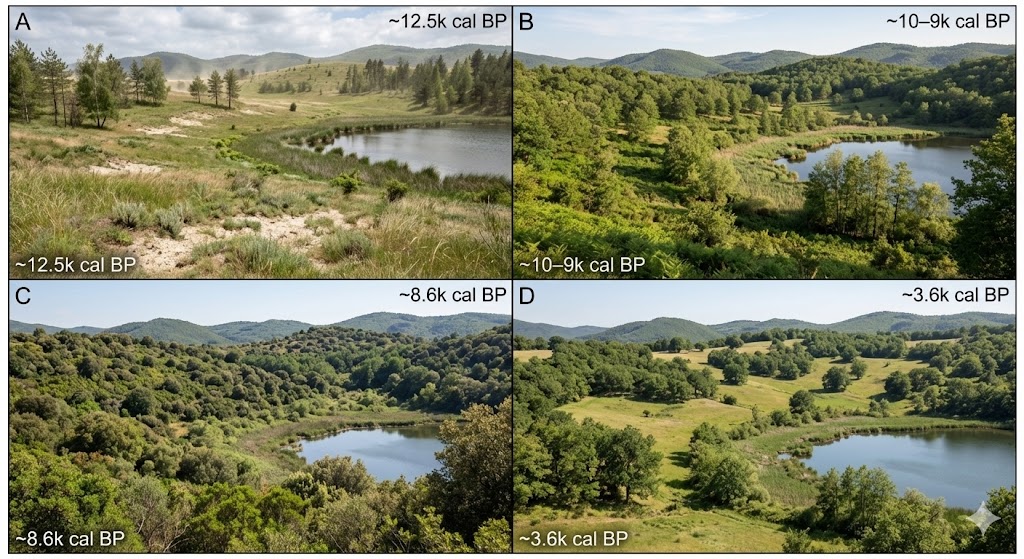
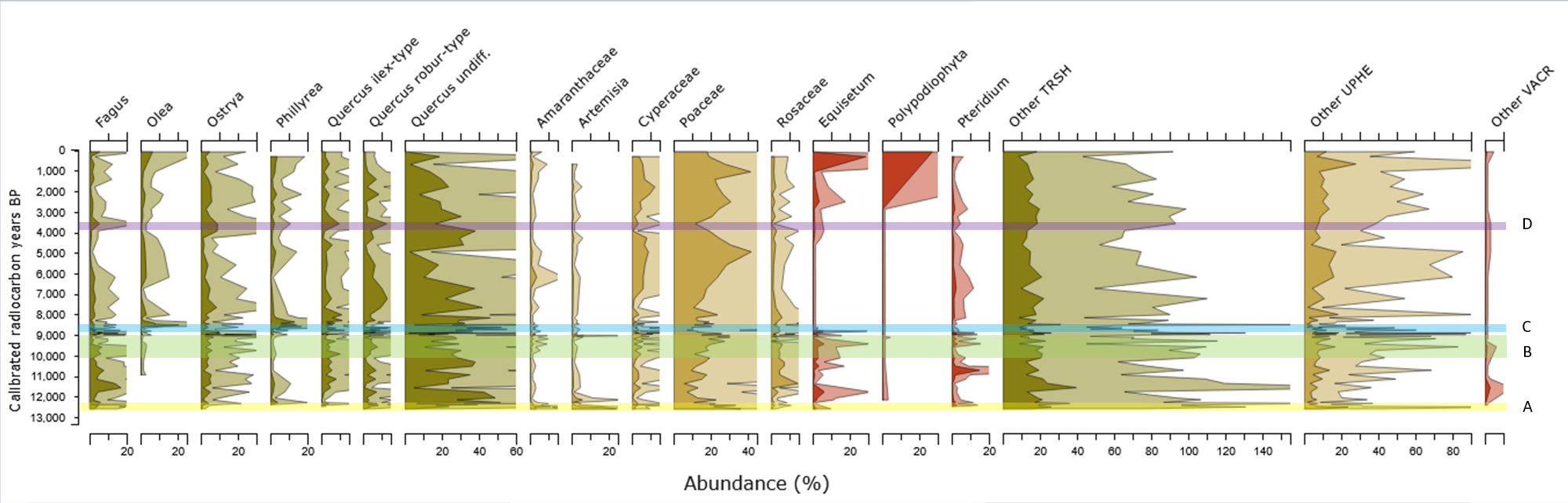
The project focuses on European diachronic data (from the end of the Pleistocene to the present) collected from the Neotoma database and involves two macro-phases:
1. Predictive Phase: A Random Forest algorithm is used to predict the possible biome present at the studied site based on pollen records. The Random Forest ensures a high level of transparency in data management.
2. Generative Phase: The predicted biome and site-specific data (such as coordinates, chronology, and species present in the pollen record) are processed using Generative Adversarial Networks (GANs) and multimodal models to generate visualizations that simulate the paleoenvironment.
The application of AI in this context presents technical challenges, such as data scarcity, and ethical challenges, such as the need to make reconstruction processes as transparent as possible. Specifically, the project’s research objectives can be summarized in three categories:
1. Predictive Capacity: To verify whether generative models can correctly interpret both modern and ancient biomes.
2. Reliability Analysis: To identify errors or biases in visual reconstructions and understand what they represent.
3. Ecological Inference: To explore how the model infers latent biodiversity by inserting species compatible with the environment even if they are not traced in the pollen record.
Throughout the research, collaboration between archaeologists, paleoecologists, and computer scientists is of particular importance (human-in-the-loop approach), both for building the predictive/generative models and for validating the outputs. The goal is to create a method that is as reproducible and interactive as possible, where experts influence the paleoenvironmental reconstruction to ensure it is scientifically reliable.
Progetto a cura di:
Elisa Paperini
eli.paperini@gmail.com
Github: https://github.com/elisa-paperini